Thursday, February 22, 2007

Novel: The Secret Life of Bees by Sue Monk Kidd

Summary:

The story is set in the 1960s in Sylvan, just after the civil rights bill has been passed. A 14-year-old white girl Lily Owens is haunted by the accidental death of her mother 10 years ago. She lives with her cold, brutal, sadistic father on a peach farm. During her childhood, Rosaleen, a good-hearted and strong African American woman, is her only companion and acts as her "stand-in mother." One day in July 1964, Rosaleen goes to town to register to vote and insults three racists of the town. She is arrested, beaten up, and hospitalized. Lily decides to rescue Rosaleen and they flee to Tiburon, a town that Lily believes her mother had a connection to. In Tiburon, the black Mary labels on the honey jars lead them to Boatwright sisters named August, June, and May. August, the beekeeper, generously takes in Lily and Rosaleen. In their home, Lily recaptures the ideas of religion and racism, and also finds the long-lost maternal love. Irresistibly, she is infatuated with a young man, a black man.

My Opinion:

I like the story of this book in the way the author presents the wisdom about life:

  • Prejudice is always caused by a lack of understanding. The author shows how life experience has changed Lily’s thinking towards Blacks and June’s negative impression towards Lily.
  • The power of love can break the barriers between humans – Lily expresses her loves toward Rosaleen and Zach, while August shows her care for Deborah and Lily.
  • Lily forgives herself for her involvement in her mother’s accidental death and also forgives her father who treats her badly.

However, I disfavor with the following:

  • The story gets tedious when Lily is reluctant to come clean with August. I really dislike Lily’s character because she is too good in lying and she likes to keep everything inside of her. What’s more, I tired of her whining.
  • The story about May’s suicide is oversimplified. It is inconvincibly to have so many things happened in 20 minutes – walk out from the house to the river, come out with an idea of suicide, write a note, and suicide. Furthermore, there is no indication of May’s tendency to commit suicide.
  • T. Ray gives in too easily to let Lily stay in August’s place.
  • The relationship between Lily and Zach is unclear at the end of the story.

There are a couple of favorite quotes from the book that I like most:

  • … women made the best beekeepers because they have a special ability built into them to love creatures that sting – it comes from years of loving children and husbands.
  • “…, some things don’t matter that much, Lily…. How big is that in the overall schema of life? But lifting a person’s heart – now, that matters. The whole problem with people is –”, “… the problem is they know what matters, but they don’t choose it. You know how hard that is, Lily?...”

For further detail about the book, please refer to: http://thebestnotes.com/booknotes/Secret_Life_Of_Bees/Secret_Life_Of_Bees01.html

Wednesday, February 21, 2007

Major Change of Daylight Saving in the USA

New Federal Law—Springing Forward in March, Back in November

Beginning in 2007, a new federal law is in effect. The federal goverment annouced extending Daylight Saving Time (DST) by about a month. This year DST will start the second Sunday of March (3/11/2007) and end on the first Sunday of November (11/4/2007). Arizona and Hawaii do not use daylight saving time.

Wednesday, February 14, 2007

Charity Auction

I was lucky to have a chance to attend a charity auction in State College. It was a biannual fundraising dinner held by Global Connections, a community non-profit organization. Generally the event was divided into two sections – the Silent and Live auctions. At 6 o'clock in the evening, guests were starting to arrive in the Ramada Inn conference room. Each of the guests was given with a personal bid number. They then walked around in the conference room to look at more than fifty auction items that were nicely displayed. The starting price and the minimum increased price were written on a sheet of paper near to a particular item. If a guest interested in an item, instead of her name, she would write down her bid number and the price that she would like to bid for on the sheet of paper. The whole process of silent auction took two hours. It ended at 8 o'clock, and the highest listed bidder won the prize. For Live auction, it took place after the guests had enjoyed their dinners. Auction catalogs were printed and distributed before the event got started. For the auction was conducted orally for people to hear, an eloquent auctioneer was needed. Again, the highest bidder won the prize. There were altogether 10 auction items in this section. All the bidders would pay the money and carried their items back home after the program. To encourage more people doing charity, the U.S. government offers tax reduction on the money that people spend for charity purposes.

Thursday, February 08, 2007

Westerner vs. Easterner

There are very dramatic social-psychological differences between East Asians as a group and people of European culture as a group.

- East Asians live in an interdependent world in which the self is part of a larger whole;
- Westerners live in a world in which the self is a unitary free agent.

- Easterners value success and achievement in good part because they reflect well on the groups they belong to;
- Westerners value these things because they are badges of personal merit.

- Easterners value fitting in and engage in self-criticism to make sure that they do so;
- Westerners value individuality and strive to make themselves look good.

- Easterners are highly attuned to the feeling of others and interpersonal harmony;
- Westerners are more concerned with knowing themselves and are prepared to sacrifice harmony for fairness.

-Easterners are accepting of hierarchy and group control;
- Westerners are more likely to prefer equality and scope for personal action.

- Asian avoid controversy and debate;
- Westerners have faith in the rhetoric of argumentation in arenas from the law to politics to science.

(Richard E. Nisbett, 2003. The Geography of Thought: How Asians and Westerners Thinks Differently ... and Why)

Wednesday, February 07, 2007

Emperor vs. King

"Is there any different between an Emperor and a King? Or they are actually the same, and it is just a matter of terminology?" asks a student in Tom's short story class, while we are talking "The Emperor's New Clothes."

I thought it is a terminology matter, but I am wrong! According to Wikipedia, an emperor is a (male) monarch, usually the sovereign ruler of an empire or another type of imperial realm, while king is a (male) monarch, or head of state. Emperors are generally recognized to be above kings in honor and rank. Empress and queen are the feminine forms of emperor and king respectively.


However, Czar, Tzar, and Tsar are the titles of former emperor of Russia. Kaiser is refered to German and Austrian emperors.

Tuesday, February 06, 2007

Story Review: A Visit of Charity

In a technology prevailing world, most people are in favor of computing electronic mail. Many electronic mail users are probably familiar with “Eudora” – an email client. However, not many of them know that the software is actually named after a Southern writer Eudora Welty. The program is developed by Steve Dorner who was inspired by Welty’s short story “Why I love at the P.O.” Eudora Welty was one among few renowned American female writers, and she was also a successful photographer. In her 92 years, she published a number of novels, short stories, photographs, essays, and one children's book. Welty uses her gift of literacy to express sympathy with human difficulties – illness, old age, poverty, and ignorance. These can be seen in the short story “A Visit of Charity.” In the story, Welty provokes thought about selfishness, callousness, negligence, and dehumanization through an ironic tone. The title itself is rather a paradox. Charity means to show kindness, humanity, and social conscience toward people in need. Nevertheless, neither the protagonist Marian nor society possesses these values.

“A Visit of Charity” is a story about a fourteen-year-old girl, Marian, who visits two old women in a nursing home. The purpose of her visit is to earn a three-point for her score in Campfire Girl. By bringing a potted plant to the nursing home, she can earn an extra one point, or a double point is counted if she brings a bible and reads it to the old ladies. Marian brings with her a potted plant. In the nursing home, she is so shocked by the inferior environs and two cantankerous old ladies. During her brief stay, she is peculiar, and her mind cannot function properly. She loses the abilities to think, see, speak, and hear clearly. She has a strong impulse to run away from this strange place, and strange elderly women. At the end, Marian leaves a crying old woman and an imploring old woman untouched. She gets back an apple she has hidden under a tree and runs to catch the bus to go home.

The story takes place on a very cold winter day at a nursing home, where the building is described as “whitewashed brick and reflected the winter sunlight like a block of ice” and is beautified by “prickly dark shrub.” These scenes imply the absence of affection and warmth from a society towards forsaken elderly people in the nursing home. Marian is the protagonist of the story. She is a self-centered person. She is concerned about the progress of her Campfire Girl points more than anything. Her visit is clearly insincere when she tells the nurse at the desk, “I’m a Campfire Girl… I have to pay a visit to some old ladies.” When the nurse asks if she is acquainted with any persons there, she answers, “No-but-that is, any of them will do.” The potted plant is more evidence that shows Marian’s selfishness. Instead of bringing fruits or other more practical and sincere presents, Marian chooses to bring a potted plant that can earn her one extra point. However, compared to the previous campfire girl who has brought a bible during her visit, Marian is considered to have a little self-awareness for she does not choose to bring a bible that can earn more extra points for her. Welty sarcastically suggests that people who use bibles as the tools for self-gaining are indeed those who are overly preoccupied with their own benefits. Their actions fly in the face of sanctification.


Marian, however, has dehumanized the two old women unconsciously too. She associates the sound of an old lady to a sheep’s bleating and the hand of another old lady to a bird's claw. When entering the tiny dark room, she is frightened by her own creative imagination, where she is being caught in a robbers’ cave. After all, these hallucinations are caused by Marian’s lack of preparation. Welty’s description of Marian’s reactions also shows the disrespect of teenagers or society toward elder generation. Through the story, Welty dramatizes the isolation life in the nursing home. In the mid-morning, the hall is quiet and the doors are closed. This suggests that most of the residents are staying in their tiny rooms with their roommates only; no one trespasses other people boundaries. Too much furniture in the room indicates that the ladies spend plenty of time in the room, and they do not socialize with other residents in the public area in the nursing home. Therefore, it is not surprising that the two old women always argue with each other. Perhaps arguing is one of the few things if it is not the only thing they can do in a day. Also, if they are not isolated, why does Addie feel miserable on her birthday, and why does nobody help to celebrate Addie’s birthday?


After listening to Addie’s dissatisfaction about her roommate and knowing that today is Addie’s birthday, Marian seems to have experienced an epiphany. She begins to realize something about the old ladies. For the first time, she asks a question, a question that refers to Addie, not a sheep, “How old are you?” Although Addie refuses to answer the question, she indeed feels warmhearted and so she cries. Needless to say, it must have been a long time since any one was concerned about her existence. Marian’s simple question means a lot to poor Addie. Unfortunately, Marian’s epiphany is too short. She becomes untouched again to the other old woman who is imploring her for a penny. Perhaps she is just confused with feeling that she has never had before – sympathy. Finally, a red apple appears at the end of the story. It is traditionally a symbol of love or knowledge. Marian retrieves a red apple from a tree implying the ignition of love from the bottom of her heart towards elderly people. Or it also can imply the knowledge she has gained from her visit to the nursing home.

“A Visit of Charity” is a story that has a moral message to the readers. The author conveys through the story the inhumane treatment in nursing homes. The nursing home lacks amenities for elderly people. The condition of the room is comparable to a jail – small, wet, dark, and closed door. A nurse acts more like a jail guard than a compassionate professional. Welty portrays Marian as an individual person or as a whole society that is insensitive to the welfare of elderly people. People in society was used to living in their own comfort zones and neglect the inferior lives of unfortunate people. The story uses campfire girls who pay visits to the nursing home for self-benefits as a mirror of the selfishness and dehumanization of society in reality. The epiphany of Marian in the story is actually a symbolic of readers’ awareness of human difficulties.

Tuesday, January 23, 2007

Weather Forecast

Today January 23, 2007 10:34:53.14


A couple of squalls

High 34 °F

Low 24 ° F

A couple of squalls

Today: Mostly cloudy with a few flurries and a heavier squall, 1-3". High 34.
Tonight: Mostly cloudy with flurries. Low 24.

A squall is a sudden, sharp increase in wind speed which usually is associated with active weather, such as rain showers, thunderstorms, or heavy snow. They usually occur in a region of strong mid-level height falls, or mid-level tropospheric cooling, which force strong localized upward motions at the leading edge of the region of cooling, which then enhances local downward motions just in its wake. Squalls refer to an increase in the sustained winds over a short time interval, as there may be higher gusts during a squall event. (From Wikipedia, the free encyclopedia)

Story Review: The Lady, or the Tiger?

Access to the online short story: The Lady, or the Tiger, by Frank R. Stockton

‘The Lady, or the Tiger?’ is an American classical short story written by Frank R. Stockton, a humorist and a writer, in year 1882. He was born Philadelphia, the seventh of thirteen children. During his life time, he published several fairy tales, humorous books, novels, and science fiction. Among many best known stories, ‘The Lady, or the Tiger?’ was Stockton's most lasting story. He used satirical writing to examine the absolute power and self-interest of leaders, the romantic relationship, passion, and trusting between lovers, the cruelty of systems, and the uncertainty of lives in a society. The story involved a jealous princess, a vindictive king, and a handsome suitor. In general, the story was written from third person’s point of view except one part where the suitor asked a question, “Which?” to the princess.

‘The Lady, or the Tiger?’ began with a description of a “semi-barbaric” king who ruled his kingdom with a heavy-hand. He enjoyed turning his wild imagination into facts. Inspired by his implacable will, he utilized an unusual form of administering justice for offenders in his kingdom. The offender could determine his own fate by selecting one of the two closed doors in the arena. He was forced by nothing and led by no one. Behind one door stood a beautiful lady hand-picked by the king and behind another door hid a ravenous tiger. If the offender picked the door with the beautiful lady behind it, he would be declared innocent and as a reward, he must marry that lady under the witness of the king, regardless of previous marital status. If the offender opened the door with the tiger behind it, then he would be deemed guilty and the tiger would tear him to pieces. The uncertain ending of the offender pleased the king and the people in the kingdom a lot, except women, who were always the victims of the system.

The king had a daughter that who was also semi-barbaric. She was the apple of his eye. One day, the king found out that the princess had taken a lover far beneath her station. He could not accept this and so he threw the suitor into prison and set a day for his trial in the arena. On the trial day, the suitor stood in the arena and looked at the princess who sat on the right side of the king. When his eyes met hers, he knew right away that the princess knew the secret behind the doors. Through telepathy, he quickly asked the princess for some indication of which door to pick. The princess was actually in quandary. If she indicated the door with the tiger, her lover would be killed on the spot. However, if she indicated the door with the lady, her lover would be forced to marry another woman, and even though he would be alive she would never be with him. Despite the dilemma, the princess responded to her lover’s question in a second. But it had been made after days and nights of deep and painful thought. The princess gave a sign to the right. Without hesitation, the suitor walked to the door on the right and opened it. At this point, the story abruptly stopped and the author left the question to the reader, “Did the tiger come out of that door, or did the lady?”

This is a great story. I like the story but not the abrupt ending, especially when the story is a cliffy. The author placed the princess, as well as the reader, in a predicament. Making a decision is hard; making a decision for a woman is even harder, as illustrated in one Chinese saying that equates the difficulty of predicting a woman’s heart as finding a needle in an ocean. If a decision must be made for the princess, I think the suitor should be led to the door with the lady behind it. But, Wait! Do not premeditate my intention; I have additional reasons to support the decision. The law forces a man to marry a lady if he did choose the right door, regardless of his previous marital status. Is there a suggestion that polygamy is legal in the kingdom? If so, the princess could marry the suitor later, regardless of the suitor’s previous marital status. At the end, the princess could save her lover and could live happily with him again.

Friday, January 19, 2007

Listen

There's a saying that you broaden your horizons through travel, but if you are curious enough to listen to other people, you can broaden your horizons without leaving your backyard.

Monday, January 01, 2007

Geography in the Age of Reconnaissance

Sipping a cup of hot coffee in a quiet café while everyone was capering with joy for the first day of 2007, I was reading an unexciting book that my husband recommended. The content of the book was dry, so I could sense I would quit reading as soon as I began. Yet I did not. The Geographical Tradition by David N. Livingstone is a renowned writing on the history and philosophy of geography, and it has become the core textbook in many universities. Having just finished the second chapter, I have already felt that my living is closely related to geography – geography is everything and everywhere. The interesting part of the book in so far is that the author claimed that geography played a leading role in the evolution of the scientific tradition, and its contributions have been to the emergence of modern science. For geography is a practical science, it has resolved a lot of questions by real-world experience.

Sunday, December 24, 2006

Class Matters

Chapter 1: Shadowy Line That Still Divide

Today, in a country of all sorts are awash in luxuries, people’s status has become harder to read from their outward appearance. The contours of class have blurred; some said they have disappeared. But in fact, class is still a powerful force in American life. Education, child rearing, health, and life span are linked tightly to class. Although in America merit has replace the old system of inherited privilege, a paradox lies at the heart of this new American meritocracy is that merit is actually partly class-based. Parent with money, education, and connections cultivate in their children the habits that the meritocracy rewards.

New research on mobility – how readily people move up or down the ladder of prosperity and status – shows there is far less of it than most people believe. The mobility in America is lower than Britain, France, Canada, some Scandinavian countries. The rise in income inequality has widening the gulf between the rich and the poor. While most people think that American is the land of opportunity, they do not realize that the mobility seems to have stagnated – the have-mores are always rich; the have-nots are always poor.

Chapter 2: Health

Three New Yorkers with three different social classes (architect, utility worker, and maid) faced a single common threat – heart attack. But in the months that followed, their experiences diverged. Comparing to the maid, the architect and the utility worker spent lesser time to recuperate. Class informed everything from the circumstances of their heart attacks to the emergency care each received, the households they returned to, and the jobs they hoped to resume. In the United States, class is a potent force in health and longevity. The more education and income people have, the less likely they are to have and die of heart disease, strokes, diabetes, and many types of cancers. They are almost invariably in the best position to learn new information early, modify their behavior, take advantage of the latest treatments, and have the cost covered by insurance.

Chapter 3: Marriage

Marriage that cross class boundary is another interesting topic discussed in Class Matters. People who marry across class lines are actually moving outside their comfort zones, into the uncharted territory of partners with a different level of wealth and education, and often, a different set of assumptions about things like manners, food, and child-rearing. In cross-class marriages, one partner will usually have more money, more options, and, almost inevitably, more power in the relationship. While most of the marriages used to involve men marrying women with less education, in America, study have found, the pattern has flipped where more women marrying men with less schooling – the combination most likely to end in divorce.

Sunday, November 26, 2006

A Matter of Definition

What Makes a Civil War, and Who Declares It So? -- New York Times (Baghdad, Nov. 25)

Is Iraq in a civil war? This is a good question. There is no answer to this question yet, because it is still a hot issue being debated among politicians, policy analysts, leaders, scholars, historians, writers, news reporters, and many others. Some said Iraq war should have been called a civil war a long time ago, but other disagreed.

This is an interesting article, isn’t it? Let’s see how these people define civil war:

Online Merriam-Webster – a war between opposing groups within a country

Iraq is mired in civil war:


Scholarly definition – (1) the warring groups must be from the same country and fighting for control of the political center, control over a separatist state or to force a major change in policy.
(2) at least 1,000 people must have been killed in total, with at least 100 from each side. (At least 50,000 reportedly killed since March 2003 in Iraq.)
(3) civil war is always a sovereign government
(4) many insurgencies and ethnic or sectarian wars are also civil wars. (Iraq civil war has elements of both an insurgencies and a sectarian war.)

Civil war does not apply in Iraq war:

Bush administration – this is no obvious political vision on the part of the Sunni-led insurgent groups
John Keegan, the British writer of war histories - the feuding groups must be vying for national authority, have leaders who publicly announce what they are fighting for and clash in set-piece battles while wearing uniforms, among other things

At last, why should we care how it is defined, if we all agree that the violence is unacceptable? Mr. Laitin, the Stanford professor answers: There is a scientific community that studies civil wars, and understands their dynamics and how they, in general, end. This research is valuable to our nation’s security.

Friday, November 24, 2006

Black Friday

Today is Black Friday, the day after Thanksgiving in the United States. It is known as the busiest retail shopping of the year in terms of customers traffic. In this day, most of the retailers start their business in the early morning and offer massive discount on their products. Due to the limited discount items, a lot of customers line up in front of the mall as early as 2:00 a.m.

In recent year, a new term Cyber Monday is created referring to Monday immediately following Black Friday. It marks the beginning of online shopping season.

The controversy of this biggest shopping day is Buy Nothing Day. Some anti-consumption activists demonstrate on this day to protest against the wasteful consumption habit of First World Countries.

This is the United States -- some can not resist the attraction from materialistic world, other prefers an austere style of life in this abundance country.

Book: Class Matters

Class Matters is a book about real human being, showing the harsh inequalities in the larger society due to the class disparities. This book is a binder of the acclaimed New York Times Series on social class in America. In Class Matters, a team of New York Times reporters explores the ways in which class – defined as a combination of income, education, wealth, and occupation – influences destiny in a society. Class Matters is truly essential reading for anyone concerned about the future of their beloved family, especially their children. Although this book is mainly about American society, its implications will benefit the way we live our lives.

I would like to share my reading with those who read this blog. I will give a brief summary and comment on each of my reading. There are altogether fourteen chapters in this book. So, feel free to send me a reminder if I keep you waiting too long. I am kind of lazy sometimes.

** The complete “Class Matters” newspaper series is available at http://www.nytimes.com/class

Wednesday, November 22, 2006

Unspoken Behavioral Rules of Americans

New York Time -- Nov 16, 2006

How do you feel when people get within
necking distance [distance of kissing & embracing] of you when they speak? Or when strangers who stand very near to you on line? Or when people who take the bathroom stall next to yours when every other one is available? Perhaps people from different cultures require different range of distance to each other. However, Americans, conquerors of the wild frontier, generally prefer more personal space than people from any other cultures. They will likely angle and inch their bodies away from anyone they feel breached their buffer zone.

Scientiests have recently found new evidence in a cyber game about this unwritten rules of personal space. Researchers found that some of the avatars' (digital representations of the humans that control them) physical behavior was
in keeping [conformity or harmony] with studies how humans protect their personal space. In other words, the digital beings adhered to some unspoken behavioral rules of humans even though they were but pixels on a screen.

I myself figured this out from my daily life experience. Most of the customers in a department store will say "excuse me" when they walk pass someone who is also at the same aisle, even though they will not brush agaist each other's backsides. This is because they do not want to disturb his or her personal space. Being an expatriate [One who has taken up residence in a foreign country], I accept and learn American way by saying "excuse me" when I need to walk pass someone who is in a close distance with me.

Vocabularies
-------------------

*sit or stand equidistant from one another like birds on a wire

*dub - to give a name to facetiously or playfully; nickname

*leer - sly or insinuating glance [the man is leering at you]
*entrench - fix in strong position
*overture - to present or make an offer or proposal to [the man's overtures of friendship...]
*critter - living creature [being touched by a strange critter]

Monday, November 13, 2006

Masquerade Ball


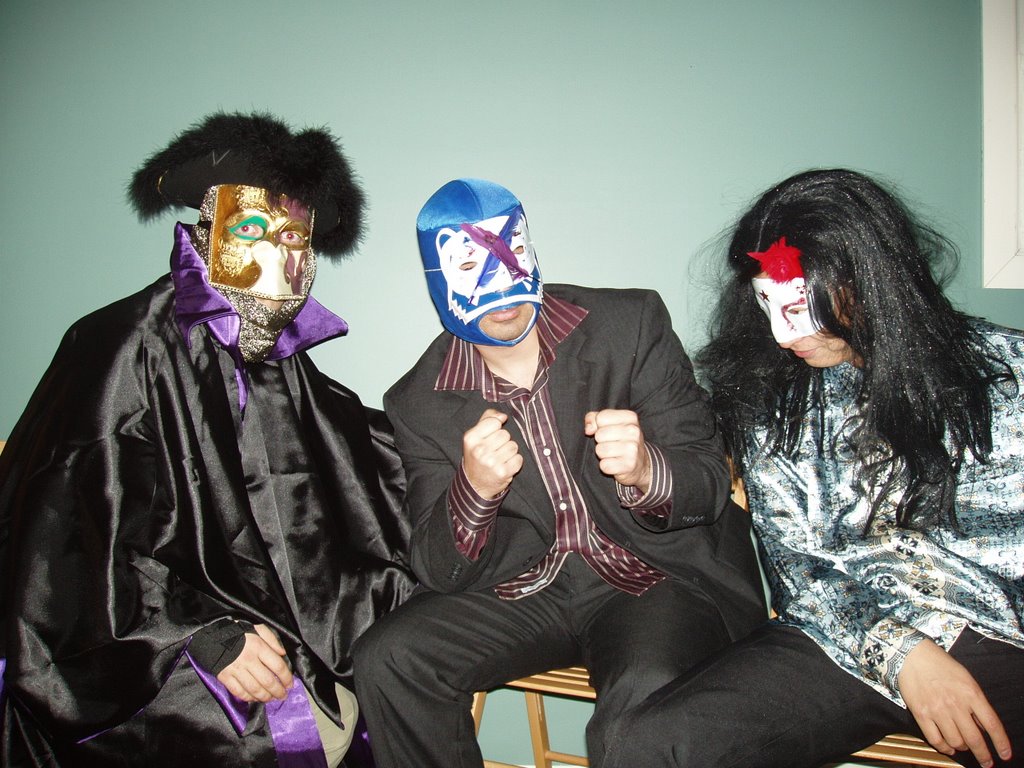
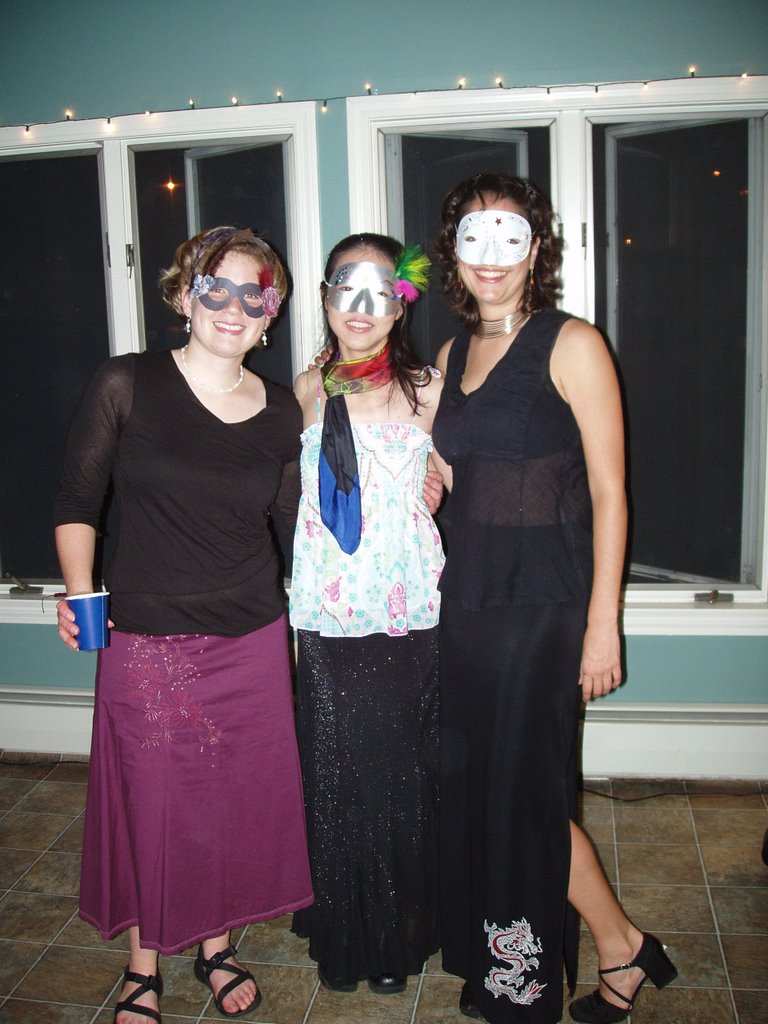
We were invited to a masquerade ball on last Saturday night. It was new to me; I have never attended this kind of party before. Participants attended in costume or dressed, usually including a mask. In the party, masked guests enjoyed eating, drinking, talking, and dancing. I didn't like dancing because I felt awkward with my clumsy body movements. On the whole, it was fun and I was glad to experience something new.

Tuesday, November 07, 2006

Hooked, Shore Anglers Catch the Sunset, and Perhaps a Bluefish

New York Time - October 21, 2006

Every year in October, while the parks and forests were packed with people who came to see fall foliage scene, there was a throng of people headed to Truman's Beach in New York to see fuchsia sunsets and cast the lines into the Sound. Although it was hardly beach weather, a cold breeze was kicking up a surf on Long Island Sound, anglers were oblivious to it all, locked in combat with bluefish and grinning for ear to ear.
  • angler ~ person who fishes with a hook on a line
  • seagulls were screeching overhead ~ make harsh shrill cry
  • oblivious ~ forgetful
  • grin/smile from ear to ear ~ to look extremely happy
  • it's suffering of an exquisite kind ~ delicately beautiful
  • fuchsia sunsets ~ bright purplish red color
  • some anglers were skunked but couldn't have been happier sharing the beach with other ~ to defeat overwhelmingly, especially by keeping from scoring
  • creek chubs ~ fresh water fish
  • the anglers cast the line ~ to throw (something, especially something light)
  • one quarry in mind ~ an object of pursuit
  • tread (trot, trodden) ~ to walk on, over, or along

Tuesday, October 24, 2006

OK, O.K., Ok, ok, okay

OK is the English term that being used ubiquitously since globalization. I guess no one will disagree with me on this point. However, have you ever thought about what does this abbreviation stand for? And where does this expression come from? Perhaps many people have the same thought as me: such a trivial word does not need to pay much attention.

Until recently, Tom brought in these questions to our short story class, given that the word OK recurred many times in the story. According to his note, the origin of OK is based on a joke of sorts. During the 1830s there was a humoristic fashion in Boston newspapers to reduce a phrase to initials and supply an explanation in parentheses. Sometimes the abbreviations were misspelled to add to the humor. In March 1839, OK was appeared in print as an abbreviation for “all correct”, the joke being that neither the O nor the K was correct.

Originally spelled with period –-O.K. is derived from OK club, which supported Martin van Buren’s 1840 campaign for reelection. Because he was born in the Kinderhook, New York, Van Buren was nicknamed Old Kinderhook, and the abbreviation O.K. proved eminently suitable for political slogans.

Because it is so widely used, the "okay" spelling of it appeared in British writing in the 1860s. In the 20th century, "okay" has come to be in everyday use among English speakers, and borrowed by non-English speakers.

Tuesday, October 10, 2006

Monarch Butterfly Migration


Being brought up in a tropical country, I have no idea about hibernation and migration that happen in four-season counties. Three years ago, I experienced the first snow in my life, in the mean time, I got the first lesson about animals hibernation and birds migration.

Today, in Barb's class, we read a science article about Monarch Butterfly migration. Whoa! Butterfly migration -- I didn't know about this before (hubby is correct, I am lack of reading). Every year at this moment, millions of Monarchs migrate between Mexico and the United States and Canada. They migrate more than 3,000 miles back and forth to winter homes. I wonder how these paper-thin wings and delicate bodies Monarchs can survive the rigors of long distance travel?

Monarchs don't have map -- so how do they know where they are going? Nobody knows the answer. Some have suggested they use the sun, mountains, and other landmarks to guide their homing system. One of the entomologist claimed that Monarchs are one of the few creatures on earth that can orient themselves both in latitude and longitude. When the sun at their latitude drops to about 57 degrees above the southern horizon, all Monarchs start migrating. But, so far, Monarch migration remains one of the great mysteries of the natural world.

We as human beings have to admit that when it comes to dealing with winter, a lot of creatures on the earth seem an awful smarter than humans. While we are shivering in the dark and griping about the weather, they simply head for a warmer climate.